


Hi, I’m Chase Roper, and I’m writing an essay about every They Might Be Giants song. If you like deep dives, nostalgia, or getting unreasonably emotional about music, subscribe below to read along for free. New posts arrive every week by email or in the Substack app.
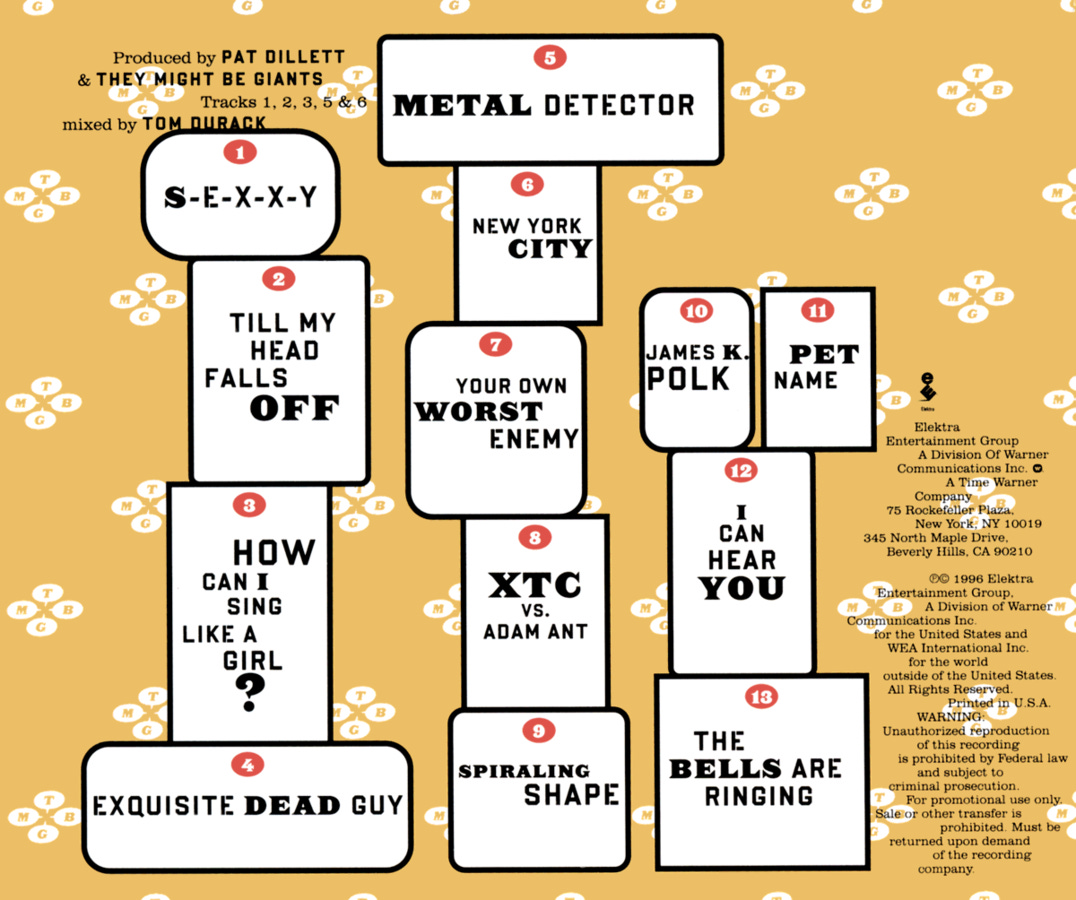
I hear Metal Detector as a literal song about a metal detector. But I also hear it as a song about a mind that never stops scanning for signs that it might get hurt.
A Beach Day, Technically
The last time I went to a sandy beach on a hot summer day was for a friend’s birthday at Alki Beach in Seattle. The friend was someone my ex-wife had known since childhood. The beach was full. The sun was doing what it does best. People swam. People played volleyball. Someone nearby was slowly sweeping the sand with a metal detector, earbuds in, fully committed to their own private mission.
The day leading up to this outing (and the day itself) was already thick with anxiety coming from my spouse. By the time we laid a small towel down in the sand, my nervous system was working overtime, trying to predict which combination of words, tone, or body language might help stabilize her mood - or accidentally make it worse.
It felt like an anxiety attack permanently parked just shy of eruption.
We sat there while she second-guessed nearly every interaction, hers and mine, with the people around us. I was corrected. I was expected to already know “the deal.” I was meant to anticipate how she might later interpret something I said, or didn’t say, or said slightly wrong.
Learning to Scan Ahead
So I did what I had learned to do.
I started scanning ahead.
I tried to pre-empt the corrections before they arrived. I adjusted myself mid-sentence. I tracked tone shifts. I watched faces. I monitored the emotional weather, hoping to steer us around an argument that hadn’t technically started yet.
While other people were swimming, playing volleyball, or casually digging for lost jewelry, I was doing my own version of treasure hunting. Searching for the earliest possible warning signs of trouble.
We left early.
Not because the beach wasn’t beautiful.
But because I was exhausted, and I wanted to avoid what felt like an inevitable, anxiety-fueled argument in the car.
When I hear Metal Detector, that’s the beach I’m standing on.
The Song at Face Value
On the surface, Metal Detector is exactly what it claims to be. John Linnell has said it’s inspired by a book about buried treasure in Casco Bay, Maine (Buried Treasure of Casco Bay by B.F. Kennedy Jr.) a guide written with such earnest zeal that it borders on obsession. A man walking beaches with a metal detector, convinced that meaning and value lie just beneath the sand, if you’re willing to ignore what everyone else is doing on the surface.
And yet, like so many They Might Be Giants songs, it refuses to stay at face value.
When I first heard Metal Detector, I experienced that classic TMBG phenomenon: you hear the song literally, but your brain won’t leave it there. You can call it projection. You can call it interpretation. You can call it extracting unintended meaning. TMBG songs are built to survive all of those uses.
The A-Plot / The B-Plot
To me, the song has an A-plot and a B-plot.
The A-plot is simple: a person walking a beach, deliberately ignoring volleyball games, gulls, seashells, bathing beauty dolls—every officially sanctioned version of fun—in favor of sweeping the ground for something hidden. The narrator isn’t anti-joy; he’s anti-distraction. He’s convinced the real story is underneath.
The B-plot is a hyper-vigilant mind doing exactly the same thing. A mind always scanning for subtle changes in facial expression.
For pattern deviations.
For shifts in tone.
For the emotional equivalent of a faint metallic ping that says something might be wrong.
If you’ve lived long enough in an environment where safety depended on reading the room correctly, you don’t stop doing this when you leave that environment. You just get better equipment. You learn to listen past what people say and focus on what changes. You become very good at detecting problems on the horizon, sometimes before they exist.
Look past the volleyball.
Ignore the mountain of discarded folderol.
In other words: ignore what everyone else says is important. Pay attention to the ground.
That kind of scanning doesn’t feel optional. It feels like responsibility. Like inspection. Like vigilance is the cost of staying upright.
Does your brain has its own detector that never quite shuts off, you might want to stick around. If you want these essays showing up quietly in your inbox, you can subscribe. No alarms. No sudden noises. Just one less thing to scan for.
Unearthing an Old Sound
Metal Detector also features something else that made my ears perk up the first time I heard it: the return of the Micromoog synthesizer.
The Micromoog hadn’t appeared prominently on a They Might Be Giants track since their earliest days; the 1983 Demo Tape, Lincoln, the era of Dial-A-Song phone lines and four-track hiss. It’s an instrument that carries history in its circuitry. When it shows up here, it doesn’t feel like nostalgia. It feels like excavation.
I first heard this song in my bedroom in high school, and when that Micromoog came in, it felt like a statement.
Not a rejection of John Henry.
Not a retreat from Factory Showroom.
But proof.
Evidence that They Might Be Giants hadn’t abandoned their earlier selves in order to evolve. They had brought those sounds with them. They were still capable of reaching back while moving forward. Still willing to dig up old tools and make them speak in new ways.
That mattered to me more than I realized at the time.
Because Metal Detector isn’t saying things were better back then. It’s saying the things worth keeping don’t stay visible on the surface. You have to return to them deliberately. You have to listen carefully. You have to be willing to look a little strange standing alone on a beach while everyone else plays.
The narrator sounds calm. Confident. Purposeful. He’s the inspector over the mine. He knows what he’s doing. He believes that if he keeps listening closely enough, something meaningful will eventually reveal itself.
And sometimes, he’s right.
The Gift and the Burden
Hyper-vigilance can uncover real things; buried danger, unspoken tension, emotional shifts others miss. It can keep you safe. It can help you understand. It can find what’s hidden.
It can also make it very hard to lie back on the sand.
The detector is useful. It’s with you all of the time. And that’s both the gift and the burden.
Maybe the trick isn’t turning it off completely. Maybe it’s learning when to set it down. When to trust that not every quiet moment contains a threat. When to let the beach just be a beach.
Still, if you hear a faint metallic ping under the surface, I understand why you’d want to listen.
Reader question: Do you have a “metal detector” like this? Something in your brain that’s always scanning for shifts, signals, or buried problems? What does it help you notice. . . and what does it make harder to enjoy?
You’re reading one of my Factory Showroom essays — an album full of oddball beauty, quiet heartbreak, and some of the band’s most elegant songwriting. Writing through this era has felt like excavating older memories with sharper tools.
Dive deeper into TMBG lore at TMBW.net (fan-run and fantastic)