
James K. Polk: The 11th President of the United States of America
Basically, A Real Bastard.
I’m writing an essay about every They Might Be Giants song. If you like deep dives, nostalgia, or getting unreasonably emotional about music, subscribe below to read along for free. New posts arrive weekly.
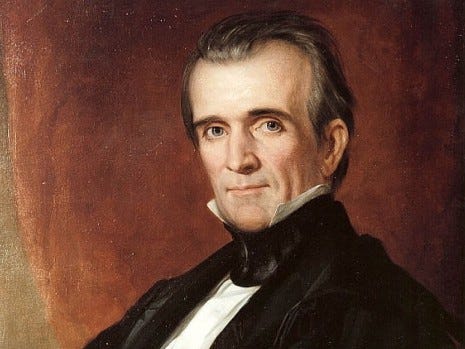
James K. Polk was born on November 2, 17951, in Mecklenburg County, North Carolina, and rose to national prominence during a period of intense political division and territorial ambition in the United States. He would go on to become the eleventh president of the United States, a figure whose legacy remains controversial.
History would eventually look back on him as a real bastard of a man. More than a century after his presidency, Polk would be immortalized in song as the subject of a very factual track by They Might Be Giants. The song appears as the tenth track on Factory Showroom, though an earlier, fan-favorite version was released years prior on an out-of-print EP (and is the personal preferred version of this biography’s author).2
The Election of 1844
In 1844, the Democratic Party was split over the issue of territorial expansion. The leading contenders for the party’s presidential nomination included Martin Van Buren, a former president and abolitionist3; James Buchanan, a seasoned diplomat perceived as a political moderate; and Lewis Cass, a military officer and outspoken advocate of westward expansion.
From Nashville emerged a relatively unknown candidate: James K. Polk. Though not considered a front-runner, Polk’s strong alignment with the doctrine of Manifest Destiny and his appeal to Southern and expansionist interests secured him the Democratic nomination. His surprise ascent earned him the nickname “Napoleon of the Stump,” a reference to his reputation as a forceful and effective speaker.
Presidency and Expansion
Polk assumed office in 1845 with a clear and aggressive agenda. Known for his austere demeanor and limited personal warmth, he governed with singular focus. His administration committed itself to territorial expansion, lower tariffs, and financial reform.
During his four-year term, Polk oversaw the annexation of Texas and pursued conflict with Mexico, resulting in the Mexican-American War. The war concluded with the Treaty of Guadalupe Hidalgo, through which the United States acquired vast territories in the Southwest.
Polk also resolved longstanding disputes with Great Britain forcing them to sell the Oregon Territory, securing U.S. claims to lands south of the 49th parallel4. In domestic policy, he reduced tariffs and built an independent treasury system5, separating federal funds from private banks.
Final Years and Legacy
Having fulfilled the major objectives he set for himself upon entering office, Polk declined to seek a second term. He left the presidency in 1849 and died shortly thereafter, on June 15 of that same year.
Though his accomplishments permanently reshaped the geographic boundaries of the United States, Polk remains a controversial figure. His expansionist policies accelerated national growth while deepening divisions over slavery and the use of military force.
James K. Polk was the eleventh president of the United States. Often overlooked. Rarely celebrated. Undeniably consequential.
You’re reading one of my Factory Showroom essays. An album full of oddball beauty, quiet heartbreak, and some of the band’s most elegant songwriting.
See all Factory Showroom posts - Start Here
Dive deeper into TMBG lore at TMBW.net (fan-run and fantastic)
181 years before I was born on November 2, 1979.
From the now out of print 1990 EP, “Istanbul (Not Constantinople)
Martin Van Buren was not an abolitionist in the modern sense. He was a Free Soiler, opposing the expansion of slavery into new territories rather than calling for its immediate abolition.
The Oregon Territory was not “purchased” from Great Britain. It was divided between the United States and the United Kingdom by the Oregon Treaty of 1846.
Polk did not build an independent treasury from scratch; he restored the Independent Treasury system, which had previously existed before being dismantled by earlier administrations.


Excellent bio! Reminds me of when, a few years back (in the high school days...), I wrote a full ~10 page essay on Mr. Polk solely because he was the president I knew most about. You'll never guess why.
As for the Istanbul EP version: I actually own an original CD pressing of it, and it definitely sounds more "right" coming out of a CD player than a crappy macbook. The singing saw in this version of the song sounds so amazing, though, I don't know that I can pick a favorite!
In 1996, I was at the show at La Luna in Portland when we corrected Their pronunciation of Oregon when they sang the song. They fixed it later! :)
also, i sang this song at karaoke a couple weeks ago